
The best pull-up bars for seniors are designed less for intense workouts and more for controlled assistance with standing, repositioning, transfers, and everyday mobility. The right choice depends on where support is needed and how securely the equipment can be installed or positioned.
This roundup includes freestanding bed trapezes, ceiling-mounted assist bars, doorway exercise bars, standing aids, bed rails, and bathroom grab bars. Prioritize verified weight capacity, stable installation, appropriate height adjustment, and compatibility with the user’s bed or room layout.
Best 10 Pull Up Bars for Seniors Picks for 2026
Best Bedside Trapeze

- 250-pound steel support frame
- Adjustable handle and strap
- Designed for bed transfers
Best For: Bedside mobility and repositioning
Best Adjustable Bed Rail
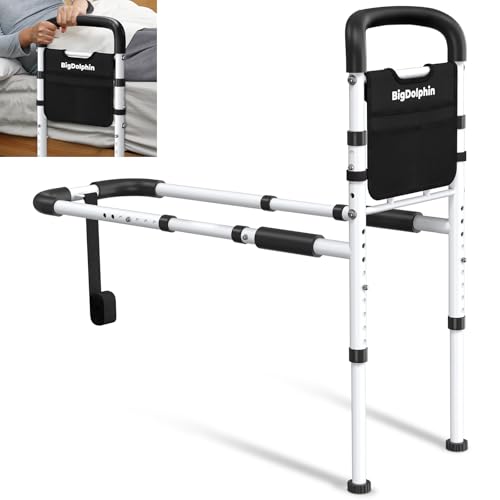
- 350-pound reinforced frame
- Adjustable fit for standard beds
- Tool-free and portable
Best For: Getting in and out of compatible beds
Best Fitness Pull-Up Bar

- 440-pound stated capacity
- Multiple exercise grips
- Removable, screw-free mounting
Best For: Upper-body workouts in a compatible doorway
Best Standing Aid

- 450-pound stated capacity
- Textured non-slip grips
- Compact for home or vehicle use
Best For: Assisted standing with a capable helper
Best Ceiling-Mounted Aid

- Assists repositioning and bed transfers
- 350-pound stated ring capacity
- Saves space with ceiling mounting
Best For: Limited-mobility users needing overhead bed assistance
Best Freestanding Bed Assist

- Adjustable height and handle strap
- 300-pound stated capacity
- Wheeled freestanding design
Best For: Movable bed transfers and repositioning
Ceiling-Mounted Assist

- Ceiling-mounted handle for bed mobility
- 45–68-inch adjustable strap
- Supports up to 350 pounds
Best For: Space-saving bed transfers and repositioning
Headboard-Clamp Support
VEVOR Bed Trapeze with Adjustable Chain

- Clamp-on design for compatible headboards
- Adjustable chain and horizontal handle movement
- 250-pound stated weight capacity
Best For: Beds with sturdy headboards under 2 inches thick
Freestanding Heavy-Duty Option
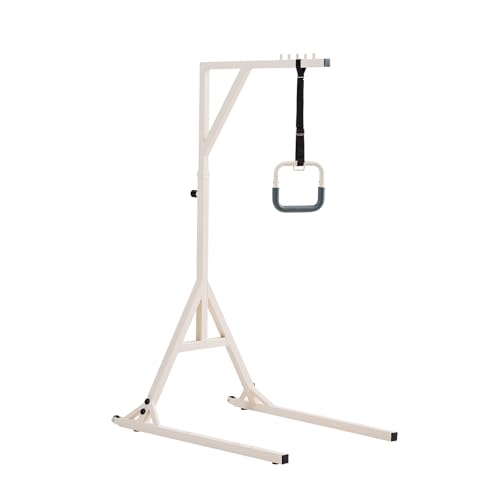
- Freestanding design needs no ceiling mount
- Adjustable height and strap positions
- Supports up to 350 pounds
Best For: Bedside transfers where floor space is available
Best Bedside Trapeze – Free-Standing Mobility Assist
For shoppers comparing pull up bars for seniors, this VEVOR trapeze bar is designed primarily for bed mobility rather than fitness. Its free-standing steel frame can help users reposition, sit up, or transfer from bed with adjustable handle positioning.
Best For: Seniors or people with limited mobility who need substantial bedside support at home, in nursing care, or during transfers.
Pros:
- Heavy-duty Q195 steel frame supports up to 250 pounds.
- Triangular reinforcement is designed to reduce wobbling and tilting.
- Adjustable strap and horizontally positionable handle allow a more tailored reach.
- Can be floor-anchored for added stability and fits under various bed types.
Cons:
- At 33.3 pounds, it is less portable than a doorway-mounted bar.
- Floor anchoring may require a more permanent installation.
- The 250-pound capacity is lower than some alternatives in this roundup.
This is the most support-oriented option here, with a broad base and installation hardware intended for controlled bedside assistance. It may also support light upper-body strengthening, but its main value is helping with bed transfers and repositioning.
Best Adjustable Bed Rail – Curved-Handle Safety Support
Among pull up bars for seniors, this adjustable bed rail is a practical choice for getting in and out of bed rather than performing full pull-ups. It combines a curved grip, adjustable dimensions, and a stabilizing leg design for everyday bedroom use.
Best For: Seniors, post-surgery users, and adults with limited mobility who need a portable assist rail for a compatible standard bed.
Pros:
- ASTM-compliant design with a reinforced frame rated for up to 350 pounds.
- 30-degree curved handle and cushioned, non-slip foam grip can reduce wrist strain.
- Adjusts from 30.3 to 35.8 inches horizontally and 16.5 to 19.7 inches vertically.
- Tool-free setup, portable construction, and included storage pouch add convenience.
Cons:
- It is not intended for adjustable beds.
- It supports bed assistance, not doorway pull-up or multi-exercise routines.
- Fit and stability depend on using a compatible bed and proper setup.
This is a strong middle-ground option for users who want a lighter, movable bed aid with more adjustability than a fixed support. Check the bed type and dimensions carefully before ordering.
Best Fitness Pull-Up Bar – Heavy-Duty Doorway Trainer
For seniors seeking pull up bars for seniors with a fitness focus, the Ally Peaks doorway bar offers multiple grips and exercises in a compact format. It uses doorway leverage rather than screws, but the frame and trim dimensions must match before use.
Best For: Active adults who want a removable home-gym bar for upper-body exercises and can safely use a doorway-mounted setup.
Pros:
- Heavy steel construction is rated for up to 440 pounds.
- Multiple grips support pull-ups, push-ups, dips, and hanging crunches.
- Silicone contact pads are designed to protect the door frame from marks.
- Portable, screw-free design fits standard 24- to 32-inch doorways within the stated depth and trim limits.
Cons:
- It requires careful doorway compatibility checks and a firm safety test before use.
- Exercise movements may be unsuitable for seniors with limited strength or balance.
- Unlike the bed-assist products, it is not designed for standing or bed transfers.
This is the roundup’s dedicated workout option, not a mobility aid. Its high stated capacity and versatile grips are useful for appropriate users, but seniors should prioritize doorway stability, controlled movement, and personal ability.
Best Standing Aid – Two-Person Lift Assist
Although it is not a conventional pull-up bar, this Liberty Lift standing aid may suit shoppers comparing pull up bars for seniors who primarily need help rising. Its non-slip grips and simple design are intended for assisted standing indoors, outdoors, or near a vehicle.
Best For: Seniors, people recovering from knee replacement, or disabled users who have a capable helper available for assisted standing.
Pros:
- Stated weight capacity is up to 450 pounds.
- Textured rubber grips are designed to help prevent the hands from slipping.
- Lightweight, compact construction is easy to carry and use in different locations.
- A rope can be attached through the hole so the aid can stand independently.
Cons:
- Use requires two people, and one helper must have sufficient strength.
- It does not provide a fixed frame or independent lifting support.
- The supplied notes do not describe height adjustment or a locking mechanism.
This compact aid is best viewed as a helper-operated standing support, not a self-service exercise bar. It can be convenient for transfers, but safe use depends heavily on the helper’s strength and coordinated handling.
Best Ceiling-Mounted Aid – Bed Trapeze for Seniors
For shoppers comparing pull up bars for seniors, this ceiling-mounted bed trapeze is designed to assist with repositioning, lifting, and transfers from bed. Its adjustable cord and included non-slip sleeves make it adaptable for home-care or hospital-style beds, but correct ceiling installation is essential.
Best For: Seniors with limited mobility who need overhead assistance getting in or out of bed.
Pros:
- Supports pulling up, changing position, and transferring to a wheelchair or seat.
- Has a stated 350-pound maximum ring capacity.
- Ceiling-mounted design saves floor and bedside space.
- Includes adjustable nylon straps, pull tabs, and non-slip plastic sleeves.
Cons:
- Requires secure installation into a suitable fixed ceiling.
- Provides overhead bed assistance rather than a general-purpose standing bar.
This is a space-saving choice when the primary need is bed mobility. Verify the ceiling structure and installation method before relying on it for transfers.
Best Bathroom Support Rail – Folding Toilet Grab Bar
Although not a traditional workout bar, this folding wall-mounted rail is a practical option for readers seeking pull up bars for seniors as bathroom support. It is intended to improve balance and stability near toilets, showers, bathtubs, or stairs, where wet surfaces can increase fall risk.
Best For: Seniors and people with limited mobility who need fixed support beside a toilet or in another high-risk area.
Pros:
- 304 stainless steel construction resists rust and fingerprints.
- Flip-up design rotates 90 degrees to save space.
- Load tested to support up to 450 pounds.
- Includes hardware for concrete and wood walls, plus a positioning template and Allen key.
Cons:
- Requires wall installation rather than freestanding placement.
- Its bathroom-support design is not intended as a bed-transfer trapeze or exercise bar.
Choose this rail when dependable, space-conscious bathroom support matters more than portability. Confirm the wall material and mounting locations before installation.
Best Freestanding Bed Assist – Adjustable Trapeze Bar
For pull up bars for seniors that focus on getting in and out of bed, this freestanding trapeze combines an adjustable frame, handle strap, and wheeled base. It can also support upper-body strengthening, while its floor-standing design avoids ceiling mounting.
Best For: Home-care, nursing-home, or hospital users who need movable assistance beside a bed.
Pros:
- Height-adjustable frame and handle strap accommodate different users.
- Reinforced Q195 steel frame has a stated 300-pound capacity.
- Two casters make the unit easier to reposition.
- Non-slip handle and reinforced base are designed to improve stability.
Cons:
- At 42.6 pounds, it is less convenient to move than a ceiling-mounted aid.
- Its large freestanding frame requires available floor space under or beside the bed.
- Assembly is required.
This is the most flexible option of the three for users who need a movable bed-assistance system. Its adjustable setup and wheels are useful, but measure the available space and follow assembly instructions carefully.
Ceiling-Mounted Assist – AOSSA Bed Trapeze
For shoppers comparing pull up bars for seniors, the AOSSA Bed Trapeze is a compact ceiling-mounted option designed for bed mobility rather than general exercise. Its handle and adjustable strap can help users reposition, rise, or transfer from bed, provided the ceiling is suitable for secure installation.
Best For: Seniors or people with limited mobility who need a space-saving assist handle beside a compatible bed.
Pros:
- Supports repositioning, standing, and transfers from bed.
- 9-inch handle accommodates a two-handed grip.
- Adjustable 45- to 68-inch strap and stated 350-pound capacity.
- Ceiling mounting avoids bedside or floor support and reduces clutter.
Cons:
- Requires secure ceiling installation and a ceiling that can support the load.
- Designed for 90- to 110-inch ceilings, so it may not suit every room.
- It is a bed-assistance device, not a standalone doorway pull-up bar.
Choose this model when overhead mounting is practical and keeping the bedside area clear matters. Verify ceiling capacity, dimensions, and installation requirements before use.
Headboard-Clamp Support – VEVOR Bed Trapeze with Adjustable Chain
This VEVOR model is one of the more adaptable pull up bars for seniors who need assistance getting in and out of bed. Its clamp-based design attaches to a suitable headboard, while the adjustable chain and movable handle allow positioning for transfers and repositioning.
Best For: Home-care or facility use where a compatible headboard is available and adjustable handle placement is useful.
Pros:
- Heavy-duty Q195 steel frame has a stated 250-pound capacity.
- Clamp design fits nursing or home beds with boards under 2 inches thick.
- Adjustable chain changes handle height, and the handle moves horizontally.
- Non-slip handle supports transfers and bed mobility.
Cons:
- Must be securely attached to a headboard that can support the user’s weight.
- Limited to headboards under 2 inches thick.
- At 20.1 pounds, it is less lightweight than a simple overhead handle.
This is a practical choice when you want adjustable positioning without installing a ceiling mount. Confirm headboard thickness and strength before relying on the trapeze for transfers.
Freestanding Heavy-Duty Option – VEVOR Floor-Stand Trapeze
For shoppers seeking pull up bars for seniors without ceiling or headboard mounting, this VEVOR floor-stand trapeze provides a freestanding alternative. Its adjustable frame and strap are intended to assist with bed transfers, repositioning, and supported upper-body activity.
Best For: Bedside care environments needing a movable, freestanding support with a higher stated capacity.
Pros:
- Heavy-duty steel frame has a stated 350-pound capacity.
- Adjustable overall height, strap height, and horizontal strap position.
- Two casters make the stand easier to move.
- Floor-standing design fits under various bed types without ceiling mounting.
Cons:
- Its 39.5-pound weight makes it less convenient to relocate than lighter designs.
- Requires adequate floor space around the bed.
- Assembly is required, even though installation is described as straightforward.
This model makes sense when a ceiling mount is unsuitable and a freestanding design is preferred. Measure the available bedside space and ensure the stand is positioned securely before use.
How We Picked the Best Pull Up Bars for Seniors
We organized these options around common senior mobility needs rather than treating every bar as a workout product. Selection factors include stated weight capacity, construction, adjustability, mounting or support method, portability, and the type of movement each product is intended to assist.
Freestanding trapezes can be useful beside compatible beds without permanent installation, while ceiling-mounted models may provide a cleaner setup when the ceiling structure has been professionally verified. Bed rails and standing aids address different transfer needs, and bathroom grab bars should be selected specifically for wet-area safety. Doorway pull-up bars are primarily fitness equipment and should not be used as a medical transfer aid unless the manufacturer explicitly supports that use.
Quick Comparison
| Product type | Best suited for | Installation or setup | Important check |
|---|---|---|---|
| Freestanding bed trapeze | Repositioning and bed transfers | Positioned beside or over the bed | Base stability and bed clearance |
| Ceiling-mounted trapeze | Fixed-location bed mobility | Permanent structural mounting | Professional mounting and ceiling strength |
| Bed rail | Rolling, sitting up, and bedside support | Secured to a compatible bed | Fit, gaps, and entrapment risk |
| Standing aid | Rising from a chair or bed | Placed on a stable floor | Base footprint and user balance |
| Grab bar | Bathroom transfers | Wall mounted | Structural attachment, not drywall alone |
| Doorway pull-up bar | Upper-body exercise | Doorframe installation | Frame compatibility and safe load rating |
Key Buying Factors for Pull-Up Bars for Seniors
Match the Bar to the Movement
For bed repositioning, a trapeze handle should be reachable without forcing the user to twist or overextend. For standing, a broad, stable support aid is generally more appropriate than a hanging bar. Bathroom users need a properly mounted grab bar that supports controlled transfers on potentially slippery surfaces.
Check Capacity and Real-World Stability
Weight ratings are not interchangeable with safe transfer ratings. Consider the user’s weight, the force created while pulling or shifting, bedding movement, and the stability of the floor, bed, wall, or ceiling. Choose a product with an appropriate margin and follow every assembly and inspection instruction.
Verify Compatibility Before Buying
Measure bed height, mattress position, doorway width, ceiling structure, wall framing, and available floor space. Casters can improve repositioning for caregivers but may require locking or careful placement before use. Confirm whether the product is intended for a home bed, hospital bed, recliner, or another specific surface.
Prioritize Grip, Reach, and Fall Prevention
Look for a comfortable handle, suitable reach, height adjustment, non-slip contact points, and secure fasteners. A mobility aid should reduce strain without encouraging a user to pull beyond their balance or strength. Stop using any bar that shifts, bends, loosens, or shows damaged hardware.
Who Should Buy Which Pull Up Bars for Seniors?
- For bed mobility: Choose a properly sized freestanding or ceiling-mounted trapeze when the user needs help repositioning or sitting up.
- For bedside transfers: A compatible bed rail or standing aid may be easier to use than a suspended handle, especially for users with limited grip strength.
- For bathroom support: Select a wall-mounted grab bar installed into suitable structural material; do not rely on suction-only products for weight-bearing support.
- For exercise: A doorway pull-up bar is the fitness-focused option, but it is not a substitute for a transfer aid or medical mobility equipment.
- For caregivers: Favor adjustable, stable designs with accessible controls and enough clearance to assist without bending or reaching awkwardly.
When in doubt, ask a physical or occupational therapist to evaluate the user’s strength, balance, bed setup, and transfer technique before purchasing. These products can provide useful support, but correct installation and appropriate use matter as much as the advertised capacity.
