
Weather, darkness, and busy schedules can make it difficult to maintain commuting fitness. The right indoor trainer lets you keep riding consistently without transporting your bike outdoors or relying on ideal conditions.
This roundup compares 10 bike trainers for commuting, including compact magnetic and fluid models as well as smart trainers with app connectivity. Use the guide below to match resistance, noise, compatibility, and budget to your training routine.
Best 10 Bike Trainers for Commuting Picks for 2026
Best All-Around Value
Sportneer Magnetic Bike Trainer

- Fits many 26–28-inch and 700C bikes
- Six handlebar-controlled resistance levels
- Stable frame with front riser block
Best For: Commuters seeking flexible indoor conditioning
Best Smart Training Upgrade
ThinkRider X2Max Smart Trainer

- Up to 2,000 watts with ±2% stated accuracy
- ANT+ and BLE connectivity for cycling apps
- Simulates gradients up to 18%
Best For: Connected workouts and virtual climbing sessions
Best Portable Fluid Option

- Progressive fluid resistance needs no adjustment
- Foldable stainless-steel frame with carry bag
- Fits most 26–29-inch and 700C wheels
Best For: Portable, storage-friendly indoor training
Best for App-Based Workouts

- Wheel-on setup keeps the rear wheel in place
- ANT+ FE-C and Bluetooth connectivity
- Zwift certified with one-month Rouvy trial
Best For: Convenient connected training with a commuter bike
Quiet Magnetic Pick
Yaheetech Magnetic Bike Trainer
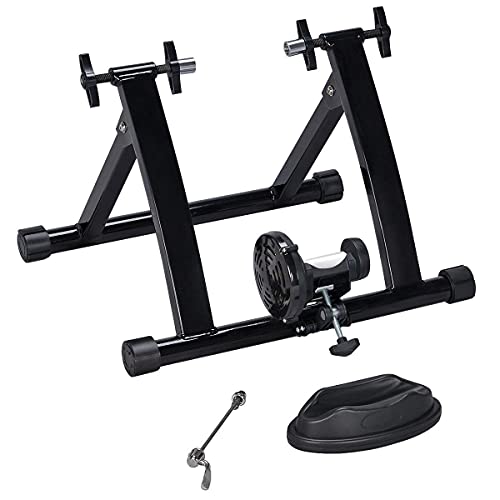
- Magnetic resistance with a sturdy steel frame
- Adjustable non-slip feet help level the stand
- Fits 26- to 28-inch and 700C quick-release bikes
Best For: Basic indoor commuting workouts with a quick-release bike
Road-Feel Upgrade
Saris Fluid2 Indoor Bike Trainer
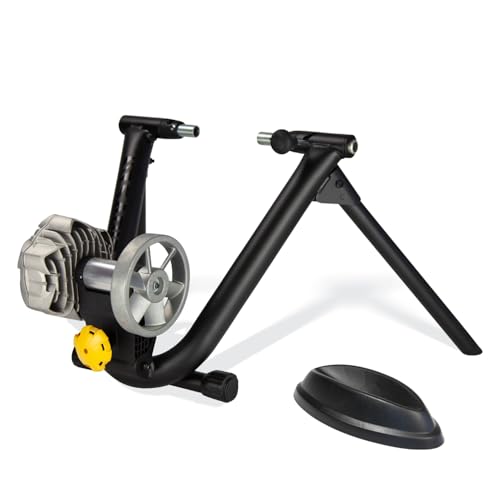
- Fluid resistance mimics progressive outdoor riding
- Foldable frame supports easy storage
- Compatible with Zwift and Rouvy using a separate sensor
Best For: Realistic indoor training for app-oriented commuters
Adjustable Folding Value

- Eight resistance levels for varied workouts
- Dual-lock mounting improves bike security
- Folds for storage and weighs 17.5 pounds
Best For: Space-conscious commuters wanting adjustable indoor resistance
Smart Indoor Training

- Smooth fluid resistance for indoor rides
- Bluetooth and ANT+ app connectivity
- Folds and supports up to 330 pounds
Best For: Road-bike commuters seeking connected indoor training
Portable Magnetic Training
Foldable Magnetic Bike Trainer Stand
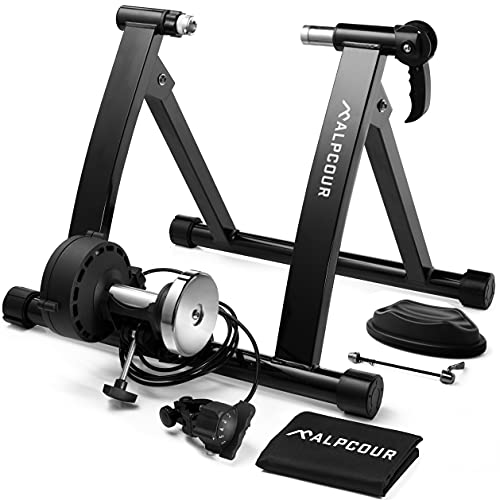
- Six handlebar-controlled resistance levels
- Stable stainless-steel foldable frame
- Includes a carrying bag and riser block
Best For: Commuters needing portable manual resistance
Simple Indoor Conditioning
Magnetic Bicycle Trainer Stand

- Six adjustable magnetic resistance levels
- Folding, tool-free setup and storage
- Supports up to 330 pounds
Best For: Commuters wanting basic indoor riding at home
Best All-Around Value – Sportneer Magnetic Bike Trainer
For riders comparing bike trainers for commuting, the Sportneer offers a straightforward way to keep a road or mountain bike active indoors. Its magnetic resistance, handlebar-mounted remote, wide wheel compatibility, and stable adjustable feet make it practical for regular conditioning when outdoor rides are not convenient.
Best For: Commuters who want an adjustable, easy-to-use indoor trainer for general fitness and endurance work.
Pros:
- Fits most bikes with 26–28-inch or 700C wheels, with a listed thru-axle option available separately.
- Six resistance levels can be changed from the handlebar-mounted remote.
- Includes a front-wheel riser block, quick-release lever, and five adjustable anti-slip feet.
- 300-pound load capacity and a one-year warranty.
Cons:
- Noise varies by tire material and tread; slick or road tires are recommended.
- It uses manual resistance levels rather than app-controlled smart resistance.
The Sportneer is a versatile choice when convenience and compatibility matter more than connected training features. Its six-level setup supports casual rides, endurance sessions, and more demanding indoor workouts without requiring a dedicated bike.
Best Smart Training Upgrade – ThinkRider X2Max Smart Trainer
Among bike trainers for commuting, the ThinkRider X2Max stands out for riders who want structured, software-connected workouts. It pairs ANT+ and BLE connectivity with up to 2,000 watts of power and automatic resistance changes for simulated climbs.
Best For: Commuters who want app-based indoor training and realistic gradient simulation.
Pros:
- Supports both ANT+ and BLE and works with mainstream cycling software such as Zwift.
- Provides up to 2,000 watts of power with stated ±2% power-meter accuracy.
- Simulates gradients up to 18% and can automatically match software-based climbs.
- Its I-beam triangular structure is designed for balance and stability.
Cons:
- Its smart features depend on compatible cycling software and wireless connectivity.
- It is a more specialized option than a basic non-connected trainer.
The X2Max is best suited to commuters who view indoor rides as performance training rather than simple exercise. Its connectivity, power capability, and variable resistance can make virtual routes and structured sessions more engaging.
Best Portable Fluid Option – Alpcour Fluid Bike Trainer
The Alpcour is a practical pick for bike trainers for commuting when you need an indoor setup that can also be stored or transported. Its fluid resistance increases as you pedal faster, while the foldable stainless-steel frame and included carrying bag support convenient storage.
Best For: Commuters who want progressive resistance and a trainer that is easy to fold, pack, and store.
Pros:
- Fluid resistance naturally increases with pedaling speed without manual adjustment.
- Foldable frame and included carrying bag make transport and storage easier.
- Compatible with most 26–29-inch and 700C wheels.
- Includes a front-wheel riser, anti-slip pads, dual tension knob, and lock ring.
Cons:
- It has one listed resistance setting and no stated app connectivity.
- Noise reduction is emphasized, but the supplied notes do not provide a decibel rating.
With progressive fluid resistance and a portable design, the Alpcour balances natural-feeling effort with everyday convenience. It is a sensible option for riders who need a dependable seasonal trainer without smart-training complexity.
Best for App-Based Workouts – Saris M2 Smart Trainer
Saris M2 Smart Indoor Bike Trainer, Compatible with Zwift App, Black, Made in the USA
Check Price On AmazonFor commuters choosing bike trainers for commuting, the Saris M2 adds connected workouts without requiring the rear wheel to be removed. Its electromagnetic resistance, dual ANT+ FE-C and Bluetooth connectivity, and Zwift certification make it useful for consistent app-guided training.
Best For: Riders who want a wheel-on smart trainer for Zwift and other compatible indoor cycling apps.
Pros:
- Wheel-on design lets you connect the bike without removing the rear wheel.
- Electromagnetic resistance provides controlled, consistent workouts.
- Connects through ANT+ FE-C and Bluetooth and is Zwift certified.
- Includes a one-month Rouvy subscription and a steel quick-release skewer.
Cons:
- Noise is listed at 69 decibels at 20 mph, so it is not the quietest option on paper.
- Stated power accuracy is ±5%, less precise than the ThinkRider’s supplied specification.
- The included skewer is intended for common quick-release road and mountain bike frames.
The M2 is a convenient middle ground for commuters who want app compatibility and measured resistance while keeping setup simple. Its wheel-on format is especially useful when the bike must switch between indoor training and outdoor riding regularly.
Quiet Magnetic Pick – Yaheetech Magnetic Bike Trainer
For riders comparing bike trainers for commuting, the Yaheetech Magnetic Steel Bike Trainer offers a straightforward way to maintain indoor cycling when weather or schedules keep you off the road. Its magnetic resistance, steel frame, adjustable feet, and compatibility with 26- to 28-inch and 700C wheels suit basic home training.
Best For: Commuters with a quick-release road or mountain bike who want a stable, low-noise indoor training setup.
Pros:
- Magnetic resistance and a steel frame provide stable indoor riding.
- Adjustable, non-slip feet help level the trainer and protect flooring.
- Shock-absorbing mounting fittings help reduce resonance.
- Includes a quick-release skewer and supports 26- to 28-inch and 700C wheels.
Cons:
- Designed for quick-release axles; thru-axle adapters are not included.
- Wheel-to-trainer friction can still create sound, especially with unsuitable tires.
- Only one resistance setting is listed.
This is a practical, uncomplicated choice for maintaining commuting fitness indoors. Use slick tires and a carpet to help reduce humming, and confirm your bike has a compatible rear quick-release wheel before buying.
Road-Feel Upgrade – Saris Fluid2 Indoor Bike Trainer
Among bike trainers for commuting, the Saris Fluid2 stands out for riders who want a more outdoor-like indoor session. Its fluid resistance progressively increases as you pedal harder, while the foldable frame and wheel-on installation keep setup and storage simple.
Best For: Commuters seeking smooth, realistic indoor rides and optional virtual training compatibility.
Pros:
- Fluid resistance provides progressive, road-like pedaling.
- Precision-balanced flywheel supports quiet, consistent performance.
- Foldable frame makes setup and compact storage easier.
- Works with platforms such as Zwift and Rouvy when paired with a separately sold speed or cadence sensor.
Cons:
- App compatibility requires a speed or cadence sensor sold separately.
- Resistance is not listed as manually adjustable.
- The supplied details do not specify a wheel-size range.
The Fluid2 is a strong fit when realistic resistance matters more than a broad set of built-in settings. Its foldable design also makes it convenient for a commuter who needs to clear indoor space after training.
Adjustable Folding Value – GYMAX Magnetic Bike Trainer
For flexible bike trainers for commuting, the GYMAX Magnetic Bike Trainer combines eight resistance levels with a folding frame. The dual-lock system, quick-release lever, adjustable roller distance, and anti-slip feet are useful for riders who want varied indoor workouts without a permanent setup.
Best For: Commuters who want adjustable resistance, secure mounting, and easy storage in a compact home gym.
Pros:
- Eight resistance levels allow easier or more challenging sessions.
- Dual-lock system helps hold the bike firmly on the stand.
- Folding design and 17.5-pound weight support portability and storage.
- Steel construction, anti-slip feet, and a 220-pound capacity provide a stable base.
Cons:
- Noise is reduced but not eliminated during use.
- The supplied details identify a 28-inch wheel size and do not list broader compatibility.
- Its 220-pound capacity is lower than some heavier-duty trainer options.
This trainer is appealing for commuters who want more resistance control than a single-setting model provides. Its foldable construction is especially useful when the trainer must be stored between rides.
Smart Indoor Training – Fluid Bike Trainer Stand
For riders comparing bike trainers for commuting, this fluid wheel-on model offers a convenient way to maintain indoor workouts when weather, traffic, or unsafe riding conditions disrupt the trip outside. It fits many 26- to 29-inch and 700c wheels without removing the rear wheel.
Best For: Road-bike commuters who want app connectivity and a stable, foldable indoor setup.
Pros:
- Fluid resistance provides a smooth, relatively quiet ride.
- Works with Zwift, Kinomap, Meilan, and TrainerRoad through Bluetooth BLE 4.0 or ANT+.
- Stable pyramid-style frame supports up to 330 pounds and folds for storage.
- Accommodates many 26- to 29-inch and 700c wheels.
Cons:
- Includes a quick-release skewer, but a thru-axle adapter must be purchased separately.
- Knobby mountain-bike tires can produce more noise.
This is the most feature-rich choice of the three for commuters who want structured app-based training. Check your bike’s axle type and tire tread before buying.
Portable Magnetic Training – Foldable Magnetic Bike Trainer Stand
For bike trainers for commuting, this magnetic stand is designed for straightforward indoor conditioning when rain, cold, or busy roads make outdoor riding inconvenient. Its handlebar controller provides six resistance settings, while the frame folds into the included carrying bag.
Best For: Commuters who want adjustable resistance, portability, and compatibility with road or mountain bikes.
Pros:
- Six resistance levels can be changed from the handlebar-mounted controller.
- Wide base, low stance, riser block, and rubber pads help keep the bike steady.
- Foldable stainless-steel frame includes a storage and travel bag.
- Fits most 26- to 28-inch and 700c wheels.
Cons:
- Magnetic resistance is not app connectivity-focused like a smart trainer.
- Compatibility is listed for most 26- to 28-inch and 700c wheels, so larger wheel setups may not fit.
- Mountain-bike tire tread may still contribute to indoor noise.
This model balances useful resistance adjustment with easy storage and transport. It is a practical option for riders who value manual control over connected training features.
Simple Indoor Conditioning – Magnetic Bicycle Trainer Stand
Among bike trainers for commuting, this magnetic stand focuses on basic indoor riding and easy storage. It accepts many 26- to 29-inch and 700c wheels, and its handlebar control lets you adjust resistance without leaving the bike.
Best For: Budget-minded commuters who want a simple folding trainer for bad-weather workouts.
Pros:
- Six adjustable magnetic resistance levels support varied indoor sessions.
- Pyramid-style construction is rated to support up to 330 pounds.
- Folds for storage and sets up without additional tools.
- Includes a quick-release skewer and front-wheel riser block.
Cons:
- Rough mountain-bike tires may create noticeable noise and vibration.
- It does not list Bluetooth, ANT+, or training-app connectivity.
- The frame material is listed as plastic, despite the iron stand material specification.
This trainer is a straightforward pick for maintaining cycling fitness indoors without smart features. Use smooth tires or place the stand on carpet to help reduce vibration and resonance.
How We Picked the Best Bike Trainers for Commuting
We focused on the features that matter most when a trainer supports regular commuting: dependable resistance, broad wheel and bike compatibility, practical setup, storage convenience, and reasonable noise levels for indoor use. The selection includes basic magnetic trainers for low-cost maintenance rides, fluid models for smoother resistance, and smart trainers for structured workouts and virtual cycling.
We also considered whether each design suits road, hybrid, or mountain bikes, how easily it can be folded or moved, and whether accessories such as a skewer, riser block, or app subscription may be needed. Always verify the exact wheel-size range and axle compatibility before ordering.
Quick Comparison
| Trainer Type | Best For | Main Advantage | Potential Limitation |
|---|---|---|---|
| Magnetic | Budget-conscious riders | Affordable, simple resistance control | Often louder and less realistic |
| Fluid | Steady endurance rides | Smoother, progressive road-like feel | Usually costs more than basic magnetic models |
| Smart | Connected training | Automatic resistance and app integration | Requires power, compatible devices, and setup |
Key Buying Factors for Bike Trainers for Commuting
Compatibility and Fit
Check wheel diameter, tire width, axle style, and frame clearance. Many wheel-on trainers support common 26- to 28-inch wheels and 700C road wheels, but thru-axle bikes may require a separate adapter. A compatible trainer-specific rear tire can also reduce slipping and wear.
Resistance and Riding Feel
Magnetic units typically offer selectable resistance levels and work well for warmups, recovery, and moderate conditioning. Fluid trainers generally deliver smoother progressive resistance, while smart trainers can adjust resistance automatically during app-based workouts.
Noise, Stability, and Storage
Noise matters in apartments or shared homes. Fluid and smart designs are often preferable for quieter, longer sessions, though tire type and cadence also affect sound. Look for a wide base, secure locking mechanism, and folding frame if the trainer must be stored after each ride.
Connectivity and Power
For Zwift or similar platforms, confirm ANT+ or Bluetooth compatibility and whether the trainer measures power or only transmits speed and cadence. Basic trainers need no electricity; smart models usually require a nearby outlet and device connection.
Who Should Buy Which Bike Trainers for Commuting?
Choose a basic magnetic trainer if you want an inexpensive way to maintain commuting fitness during rain, winter, or busy weeks. These are best for straightforward rides and occasional use.
Choose a fluid trainer if you expect longer sessions and want smoother, more natural resistance without the full cost or complexity of a smart system.
Choose a smart trainer if structured workouts, virtual routes, automatic resistance, and performance tracking will help you ride more consistently. It is the strongest choice for dedicated indoor training, provided your bike and devices are compatible.
