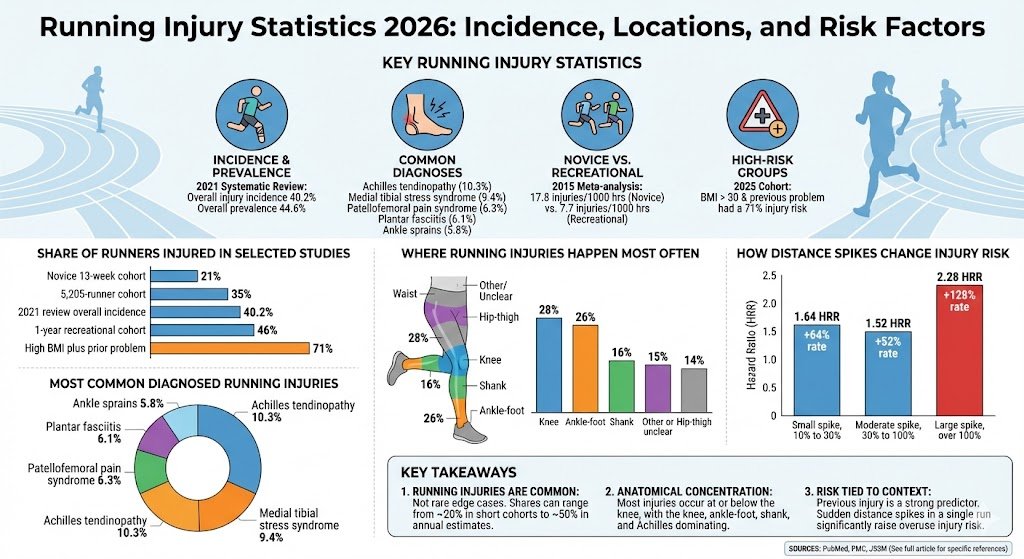
Running injuries remain common across novice, recreational, and higher-risk runner groups. The research is consistent on three points: a large share of runners get injured within a year, most injuries happen at or below the knee, and previous injury is one of the clearest predictors of another problem.
Because studies use different injury definitions, training populations, and follow-up periods, percentages should be compared carefully. Even so, the direction of the evidence is clear: running injuries are common, concentrated in the lower limb, and strongly influenced by training load and injury history.
running injury statistics
Key running injury statistics
A 2021 systematic review reported an overall running injury incidence of 40.2% and an overall prevalence of 44.6%.
The same review found Achilles tendinopathy accounted for 10.3% of incident injuries, medial tibial stress syndrome 9.4%, patellofemoral pain syndrome 6.3%, plantar fasciitis 6.1%, and ankle sprains 5.8%.
A 2015 meta-analysis reported 17.8 injuries per 1,000 running hours in novice runners versus 7.7 in recreational runners.
In a 13-week prospective cohort, 21% of novice runners sustained at least one running-related injury.
A 2021 one-year prospective cohort found a cumulative injury incidence of 46% in recreational runners.
A 2019 systematic review found 70% of reported running injuries occurred at or below the knee.
That same review reported the knee accounted for 28% of injuries, ankle-foot 26%, shank 16%, hip-thigh 14%, and other or unclear locations 15%.
A 2025 cohort of 5,205 runners found 35% sustained a running-related injury during follow-up.
In that 2025 cohort, small single-session distance spikes raised overuse injury rate by 64%, moderate spikes by 52%, and large spikes by 128%.
A 2025 cohort study found runners with BMI above 30 and a previous running-related problem had a 71% injury risk.
Share of runners injured in selected studies
This chart compares injury proportions reported in widely cited running injury studies and high-risk runner groups.
Label
Bar
Value
Novice 13-week cohort
21%
5,205-runner cohort
35%
2021 review overall incidence
40.2%
1-year recreational cohort
46%
High BMI plus prior problem
71%
Max = 71. Widths: Novice 13-week cohort 29.58%, 5,205-runner cohort 49.30%, 2021 review overall incidence 56.62%, 1-year recreational cohort 64.79%, High BMI plus prior problem 100.00%.
Where running injuries happen most often
A broad lower-limb review found that most reported running injuries were concentrated at or below the knee.
Label
Bar
Value
Knee
28%
Ankle-foot
26%
Shank
16%
Other or unclear
15%
Hip-thigh
14%
Max = 28. Widths: Knee 100.00%, Ankle-foot 92.86%, Shank 57.14%, Other or unclear 53.57%, Hip-thigh 50.00%.
Most common diagnosed running injuries
When injuries are grouped by diagnosis instead of body region, the same few conditions keep appearing near the top.
One large recent cohort suggests that abrupt jumps in a single run can materially raise overuse injury risk.
Label
Bar
Value
Small spike, 10% to 30%
1.64 HRR
Moderate spike, 30% to 100%
1.52 HRR
Large spike, over 100%
2.28 HRR
Max = 2.28. Widths: Small spike, 10% to 30% 71.93%, Moderate spike, 30% to 100% 66.67%, Large spike, over 100% 100.00%.
What the data shows
The main takeaway is that running injuries are not rare edge cases. In shorter novice cohorts the share can be around one in five, while broader annual estimates in recreational runners often land closer to one in three or even one in two.
The second takeaway is anatomical concentration. Most injuries occur at or below the knee, with the knee, ankle-foot complex, shank, and Achilles region dominating the evidence base.
The third takeaway is that risk is strongly tied to context. Previous injury remains one of the strongest predictors of a future injury, and sudden distance spikes in a single run can push risk up sharply.