
The right bike trainer can turn your existing bicycle into a reliable indoor training setup for structured workouts, winter riding, or convenient everyday exercise. The best choice depends on how much you value realistic resistance, app connectivity, portability, and quiet operation.
We compare 10 options across smart trainers, wheel-on designs, rollers, and simple magnetic stands so you can match your budget and riding goals to the right setup.
Best 10 Bike Trainer Picks for 2026
Premium Smart Trainer
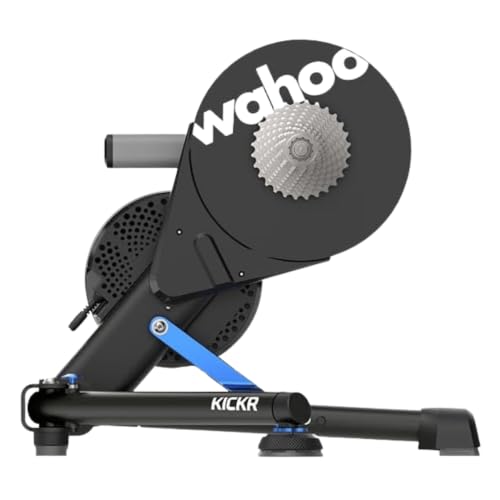
- Wi-Fi connectivity for stable data transfer
- 2,200W resistance with +/- 1% accuracy
- AXIS feet enhance outdoor-like movement
Best For: Serious cyclists seeking precise, connected indoor training
Travel-Ready Trainer

- Weighs just 14 pounds with travel bag
- Supports 16- to 29-inch wheels
- Progressive resistance with quiet aluminum rollers
Best For: Traveling riders and race-day warm-ups
Zwift-Ready Smart Trainer

- Includes Zwift Cog and Click
- Integrated Wi-Fi enables pairing and updates
- Smooth resistance for structured training
Best For: Zwift riders wanting a simple connected setup
High-Power Value Trainer

- Up to 2,000W power and 18% slope simulation
- ANT+ and BLE support for training software
- Stable I-beam design with approximately 58 dB noise
Best For: Riders wanting steep-slope simulation and high resistance
Premium Wheel-On Choice

- Magnetic resistance with five settings
- 250-pound load capacity
- Carbon-steel construction
Best For: Riders wanting a sturdy, high-capacity indoor trainer
Quiet Road-Feel Pick
Saris Fluid2 Indoor Bike Trainer
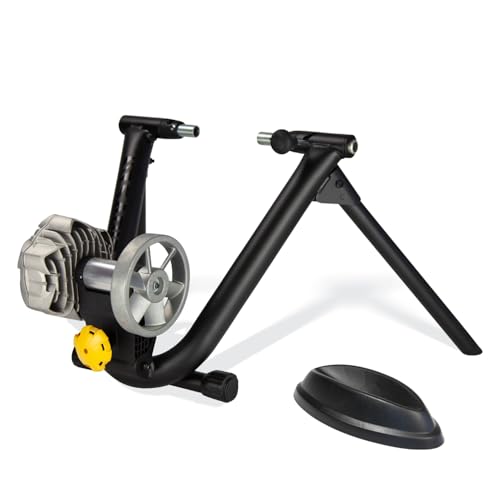
- Smooth fluid resistance
- Foldable aluminum frame
- Works with Zwift and Rouvy using a sensor
Best For: Road, mountain, and hybrid-bike riders training indoors
Budget Adjustable Stand
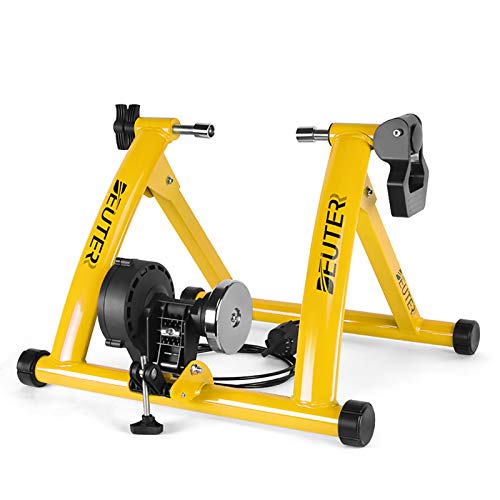
- Six handlebar-adjustable resistance levels
- Fits 26–29-inch and 700c wheels
- 330-pound load capacity
Best For: Affordable indoor exercise with flexible wheel compatibility
Quiet App-Ready Pick

- Quiet magnetic resistance
- Five adjustable levels
- Zwift-compatible design
Best For: App-connected indoor training with common road or mountain bikes
High-Capacity Folding Value

- 330-pound load capacity
- Six handlebar-adjustable levels
- Folds for storage
Best For: Portable indoor training with 26- to 29-inch or 700c wheels
Stable Black Folding Stand
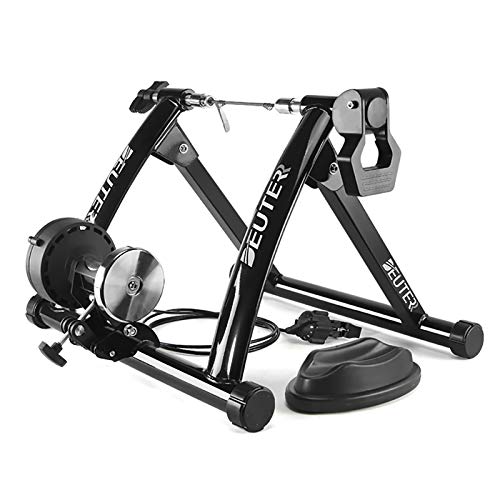
- 330-pound support capacity
- Six resistance settings
- Folding steel frame
Best For: Stable, storable training for road and mountain bikes
Premium Smart Trainer – Wahoo KICKR V6
The Wahoo KICKR V6 is a high-end bike trainer for riders who want stable connectivity, realistic movement, and precise resistance for demanding indoor sessions. Its built-in Wi-Fi and automatic calibration make setup and ongoing training more convenient.
Best For: Serious cyclists who prioritize accurate power and a realistic road-like ride feel.
Pros:
- Built-in 2.4 GHz Wi-Fi provides a stable connection for ride data.
- Up to 2,200 watts of resistance with accuracy to within +/- 1%.
- AXIS feet and the high-inertia flywheel add natural side-to-side movement and ride feel.
Cons:
- At 22 kg, it is relatively heavy to move or store.
- The one-year warranty is shorter than some competing options.
The KICKR V6 is a strong choice when precision and immersive indoor training matter more than portability. Automatic calibration and broad road, mountain, and hybrid bike compatibility add practical value.
Travel-Ready Trainer – Feedback Sports Omnium
The Feedback Sports Omnium is a portable bike trainer designed for warm-ups, travel, and flexible indoor use. Its fork-mount design accepts a wide range of wheel sizes and axle standards, while progressive resistance creates a more natural workout feel.
Best For: Riders who need a lightweight trainer for travel, race-day warm-ups, or compact storage.
Pros:
- Lightweight 14-pound design includes a heavy-duty travel bag.
- Fits 16- to 29-inch wheels and supports thru-axle and quick-release systems.
- Progressive resistance and machined aluminum rollers support smooth, quiet riding.
Cons:
- Its 225-pound load capacity is lower than some full-size trainers.
- It is a fork-mount trainer rather than a direct-drive smart trainer.
The Omnium stands out for portability rather than connected training features. Choose it if easy transport and broad bike compatibility are more important than maximum smart-trainer functionality.
Zwift-Ready Smart Trainer – Wahoo KICKR CORE 2
The Wahoo KICKR CORE 2 with Zwift Cog and Click is a practical bike trainer for riders starting or expanding a connected indoor setup. It combines smooth resistance with integrated Wi-Fi, simplified setup, and the included Zwift controls.
Best For: Zwift users who want a stable, easy-to-set-up smart trainer with a smooth ride feel.
Pros:
- Includes the third-generation Zwift Cog and Click.
- Integrated Wi-Fi supports faster pairing and automatic updates.
- Designed for hard efforts and structured training with road-like resistance.
Cons:
- The cassette is not listed among the included components, so setup requirements should be checked carefully.
- At 13.6 kg, it is less portable than the Omnium.
The KICKR CORE 2 offers a useful balance of connected features and straightforward setup. Its Zwift-focused package makes it especially appealing for riders who plan to train regularly in a virtual cycling environment.
High-Power Value Trainer – ThinkRider X2Max
The ThinkRider X2Max is a smart bike trainer that combines ANT+ and Bluetooth connectivity with up to 2,000 watts of power and simulated gradients up to 18%. Its electromagnetic resistance and stable I-beam structure are suited to immersive indoor sessions.
Best For: Riders seeking high resistance, virtual incline simulation, and broad software compatibility.
Pros:
- Supports ANT+ and BLE and works with software such as Zwift.
- Simulates gradients up to 18% with power output up to 2,000 watts.
- Reported noise level is about 58 dB at 30 km/h, and the I-beam structure promotes stability.
Cons:
- The listed power-meter error is +/- 2%, less precise than the KICKR V6.
- A cassette is not included.
- The warranty is limited to one year.
The X2Max is a compelling option for riders who value steep virtual climbs and high resistance at a potentially lower tier than flagship trainers. Confirm cassette requirements before installation.
Premium Wheel-On Choice – Wahoo KICKR ROLLR
The Wahoo KICKR ROLLR is a substantial bike trainer with magnetic resistance and five settings. Its carbon-steel construction and 250-pound load capacity make it a sturdy option for indoor cycling, particularly for riders who want a robust setup for compatible mountain bikes.
Best For: Riders seeking a sturdy magnetic bike trainer with a high load capacity.
Pros:
- Magnetic resistance with five settings.
- Supports loads up to 250 pounds.
- Includes the trainer, AC power adapter, and owner’s manual.
- Carbon-steel frame and one-year manufacturer warranty.
Cons:
- Weighs 25 kg, so it is not especially lightweight.
- The supplied notes identify mountain bikes as the compatible bike type.
Choose this model when a durable, heavier-duty construction matters more than portability. Its five resistance settings provide useful adjustment, while the included power adapter simplifies initial setup.
Quiet Road-Feel Pick – Saris Fluid2 Indoor Bike Trainer
The Saris Fluid2 is a practical bike trainer for road, mountain, and hybrid bikes. Its fluid resistance is designed to deliver a smooth, road-like feel, while the foldable aluminum frame supports quick wheel-on installation and compact storage.
Best For: Riders who want a quiet, smooth wheel-on trainer with app compatibility.
Pros:
- Fluid resistance provides progressive resistance as you pedal harder.
- Precision-balanced flywheel supports quiet, consistent operation.
- Foldable frame makes setup and storage easier.
- Compatible with Zwift and Rouvy when paired with a separately sold speed or cadence sensor.
Cons:
- A separate speed or cadence sensor is required for the listed training-app compatibility.
- The trainer has one resistance setting rather than multiple manual settings.
The Fluid2 is a strong fit for everyday indoor training when smooth operation and simple storage are priorities. Its limited one-setting specification may be less appealing to riders seeking built-in resistance adjustment.
Budget Adjustable Stand – Folding Magnetic Bike Trainer
This folding magnetic bike trainer offers six handlebar-adjustable resistance levels and fits bicycles with 26- to 29-inch wheels, including 700c sizes. Its pyramid-style alloy-steel structure supports up to 330 pounds, making it a versatile choice for basic indoor riding and exercise.
Best For: Budget-minded riders who need adjustable resistance, broad wheel compatibility, and easy storage.
Pros:
- Six resistance levels can be adjusted from the handlebars.
- Fits 26- to 29-inch wheels, including 700c.
- Supports up to 330 pounds.
- Folding design allows tool-free setup, removal, and storage.
Cons:
- Rough mountain-bike tires may create more noise and vibration indoors.
- The frame material is listed as plastic, despite its alloy-steel structural material.
- The supplied warranty description is limited to “1.”
This model is useful when adjustability and high load capacity are more important than premium refinement. For quieter sessions, the notes recommend smooth tires and placing a carpet beneath the trainer.
Quiet App-Ready Pick – Saris Mag and Mag Plus
Saris Magnetic Indoor Bike Trainer, Magnetic Resistance, Compatible with Zwift App
Check Price On AmazonThe Saris Mag and Mag Plus is a practical bike trainer for riders who want magnetic resistance, straightforward setup, and compatibility with Zwift and other indoor cycling apps. Its five resistance levels support varied workouts, while compatibility with common road and mountain bike frames makes it a versatile option.
Best For: Riders seeking a durable, app-compatible indoor trainer with quiet magnetic resistance.
Pros:
- Magnetic resistance is designed for smooth, quiet operation.
- Five resistance settings allow workout intensity adjustments.
- Compatible with Zwift and other indoor cycling apps.
- Fits common road and mountain bike frames with 120mm, 130mm, and 135mm dropout spacing.
Cons:
- It uses five resistance settings rather than continuous adjustment.
- Compatibility still depends on the bike frame and dropout spacing.
With its app compatibility, alloy-steel frame, and limited lifetime warranty, this Saris bike trainer is a strong choice for consistent indoor training and riders who value established construction.
High-Capacity Folding Value – Red Magnetic Bike Trainer
This magnetic bike trainer is built for riders who want a stable, portable stand for indoor exercise. Its pyramid-style structure supports loads up to 330 pounds, while six handlebar-adjustable resistance levels make it easy to change effort during a session.
Best For: Riders who need a foldable, high-capacity trainer for 26- to 29-inch or 700c wheels.
Pros:
- Supports bikes with 26- to 29-inch wheels, including 700c.
- Six resistance levels can be adjusted from the handlebars.
- Folds for easier carrying and storage.
- Includes a quick-release skewer and front wheel riser block.
Cons:
- Rough mountain-bike tires may produce more indoor noise.
- The supplied details list a one-year warranty.
The red model combines broad wheel compatibility, a 330-pound load capacity, and tool-free setup into a practical home bike trainer. A smooth tire and a mat may help limit vibration and resonance.
Stable Black Folding Stand – Black Magnetic Bike Trainer
The black version of this magnetic bike trainer offers a stable indoor platform for road and mountain bikes. It accommodates 26- to 29-inch wheels and 700c sizes, folds for storage, and provides six resistance levels controlled from the handlebars.
Best For: Home cyclists who want a sturdy, foldable trainer with broad wheel compatibility.
Pros:
- Steel construction and a pyramid-style frame support up to 330 pounds.
- Six magnetic resistance levels provide adjustable workout difficulty.
- Folding design simplifies storage and transport.
- Includes a quick-release skewer and front wheel riser block.
Cons:
- Knobby mountain-bike tires can be loud on indoor trainers.
- The product details list a one-year warranty.
This black model is a sensible bike trainer for riders prioritizing stability and storage convenience. Its wide wheel fit and handlebar resistance control make it adaptable for routine indoor rides.
How We Picked the Best Bike Trainers
We evaluated these Bike Trainers by looking at resistance technology, compatibility, setup requirements, portability, expected noise, stability, and overall use case. Smart models were considered for their app connectivity, power control, and virtual-riding features, while basic trainers were judged on simplicity, adjustability, and value.
Compatibility is especially important. Check whether a trainer supports your wheel size, axle standard, cassette or freewheel, tire type, and bicycle frame. For smart training, confirm support for the apps and wireless standards you plan to use, such as Bluetooth or ANT+.
Quick Comparison
- Best for advanced structured training: Direct-drive smart trainers with electronically controlled resistance.
- Best for most indoor cyclists: A midrange smart trainer that balances accuracy, connectivity, and price.
- Best for convenient setup: Wheel-on trainers that work with common road and mountain bikes.
- Best for travel: Compact portable trainers and rollers with carrying bags or foldable frames.
- Best for a low budget: Magnetic trainers with manual resistance and fewer electronic requirements.
Key Buying Factors for a Bike Trainer
Resistance and Training Control
Smart resistance lets compatible apps automatically change difficulty for hills, intervals, and virtual courses. Fluid trainers generally provide a smoother progressive feel than basic magnetic models, while magnetic units are often more affordable and easier to operate.
Direct-Drive Versus Wheel-On
Direct-drive trainers remove the rear wheel and connect to the bike’s drivetrain. They typically offer better stability, less tire wear, and more accurate power measurement, but may require a compatible cassette and more involved setup. Wheel-on models clamp the rear wheel against a resistance unit, making them simpler and often more versatile.
Noise, Space, and Portability
Consider where you will ride and store the trainer. A quieter direct-drive unit can be preferable in shared spaces, while a folding magnetic trainer may suit occasional use. Rollers and portable designs can be convenient for travel but may require more balance and rider attention.
Bike and App Compatibility
Verify wheel-size ranges, axle compatibility, drivetrain requirements, and clearance before buying. If you use Zwift or another training platform, confirm that the trainer can transmit the necessary speed, cadence, power, or controllable-resistance data.
Who Should Buy Which Bike Trainer?
Choose a premium smart trainer if you train regularly, want automated resistance, or need accurate performance data. Choose a midrange smart or fluid trainer if you want a strong balance of realism and value without paying for every advanced feature. Choose a portable trainer or rollers if storage and travel matter most. Choose a basic magnetic trainer if you primarily want an inexpensive way to ride indoors and do not need connected workouts.
