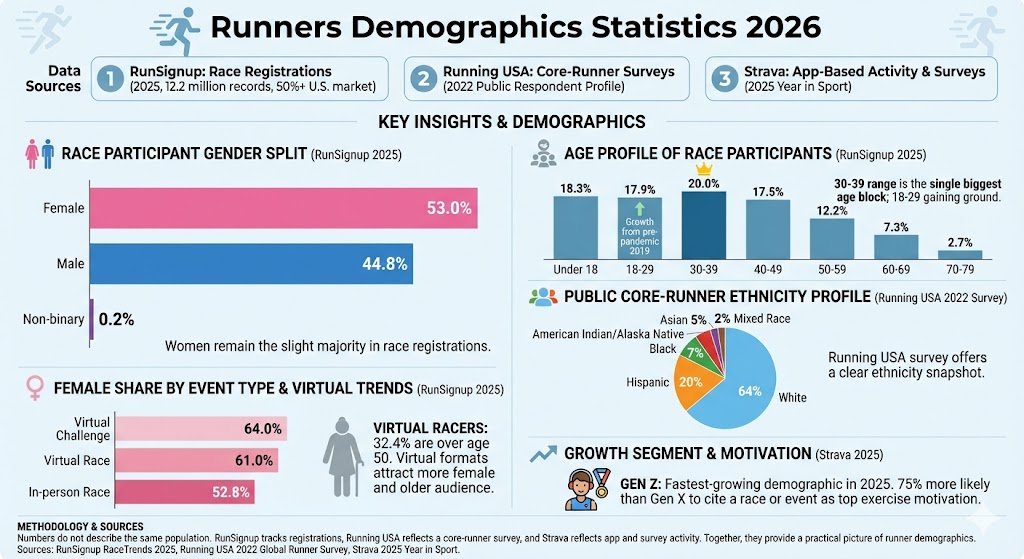
Runner demographics vary depending on whether you look at race registrations, core-runner surveys, or app-based activity data. Recent U.S. race-registration data shows women still make up a slight majority of participants, the biggest age band is 30-39, and virtual formats continue to attract a more female and older audience. Survey data from Running USA adds a wider profile for age and ethnicity, while Strava points to Gen Z as an important growth segment.
runners demographics statistics
Key runners demographics statistics
RunSignup said its 2025 dataset included 12.2 million registrations and represented at least 50% of the U.S. race registration market.
Women accounted for 53.0% of 2025 race participants, versus 44.8% for men and 0.2% for non-binary participants.
The largest 2025 race-participant age group was 30-39 at 20.0%.
Runners aged 18-29 made up 17.9% of 2025 participants, above the pre-pandemic 2019 level cited by RunSignup.
RunSignup said 32.4% of all virtual racers were over age 50 in 2025.
Women made up 64.0% of virtual challenge participants, 61.0% of virtual race participants, and 52.8% of in-person participants.
Running USA’s 2022 public respondent profile showed runners were 55% female, 43% male, and 2% non-binary.
That same Running USA profile showed the largest age groups were 25 to 34 and 35 to 44, both at 24%.
Running USA’s public ethnicity profile showed 64% White, 20% Hispanic, 7% Black, 5% Asian, and 2% each for American Indian or Alaska Native and mixed race respondents.
Strava said Gen Z was its fastest-growing demographic in 2025 and that Gen Z users were 75% more likely than Gen X to say a race or event was their top exercise motivation.
Race participant gender split in 2025
RunSignup’s latest race-participation data shows the U.S. race audience still leans female, though the gap is narrower than it was several years ago.
Label
Bar
Value
Female
53.0%
Male
44.8%
Non-binary
0.2%
Max = 53.0%. Widths: Female 100.00%, Male 84.53%, Non-binary 0.38%.
Age profile of race participants in 2025
The 2025 race-participant mix shows a broad spread across age groups, but the single biggest cohort is still runners aged 30-39.
Label
Bar
Value
Under 18
18.3%
18-29
17.9%
30-39
20.0%
40-49
17.5%
50-59
12.2%
60-69
7.3%
70-79
2.7%
Max = 20.0%. Widths: Under 18 91.50%, 18-29 89.50%, 30-39 100.00%, 40-49 87.50%, 50-59 61.00%, 60-69 36.50%, 70-79 13.50%.
Public core-runner ethnicity profile
Public race-registration datasets do not always publish ethnicity breakdowns, so Running USA’s survey offers one of the clearest public snapshots of the broader runner base.
Label
Bar
Value
White
64%
Hispanic
20%
Black
7%
Asian
5%
American Indian or Alaska Native
2%
Mixed race
2%
Max = 64%. Widths: White 100.00%, Hispanic 31.25%, Black 10.94%, Asian 7.81%, American Indian or Alaska Native 3.13%, Mixed race 3.13%.
Female share by event type
Women are the majority across every race format in the public RunSignup breakdown, but the female share is highest in virtual formats.
Both the race-participation data and the public core-runner survey point in the same direction. Women make up a slight majority of runners in organized events and in public survey snapshots, even if the exact share changes by source.
The 30-39 range remains the biggest age block
The current race mix is broad, but runners aged 30-39 remain the single largest age group in RunSignup’s 2025 participant data. That makes this band especially important for race organizers, apparel brands, and training platforms.
Younger adults are gaining ground again
RunSignup’s 18-29 share increased to 17.9% in 2025. That suggests younger adult participation has improved compared with the years immediately before the pandemic, even if it still sits below earlier cycle highs.
Virtual races attract a different audience
Virtual formats skew more female and older than in-person events. That matters because it suggests virtual participation is not just an extension of the in-person market. It behaves like a slightly different demographic channel.
Gen Z is becoming more important to running growth
Strava’s latest trend report suggests the next growth wave is being shaped by younger athletes who are motivated by events, community, and social participation as much as by traditional competition.
Methodology note
These numbers do not all describe the same population. RunSignup tracks race registrations, Running USA reflects a public survey of core runners, and Strava reflects platform and survey-based activity insights. Together, they provide a practical picture of runner demographics rather than a single census of all runners.