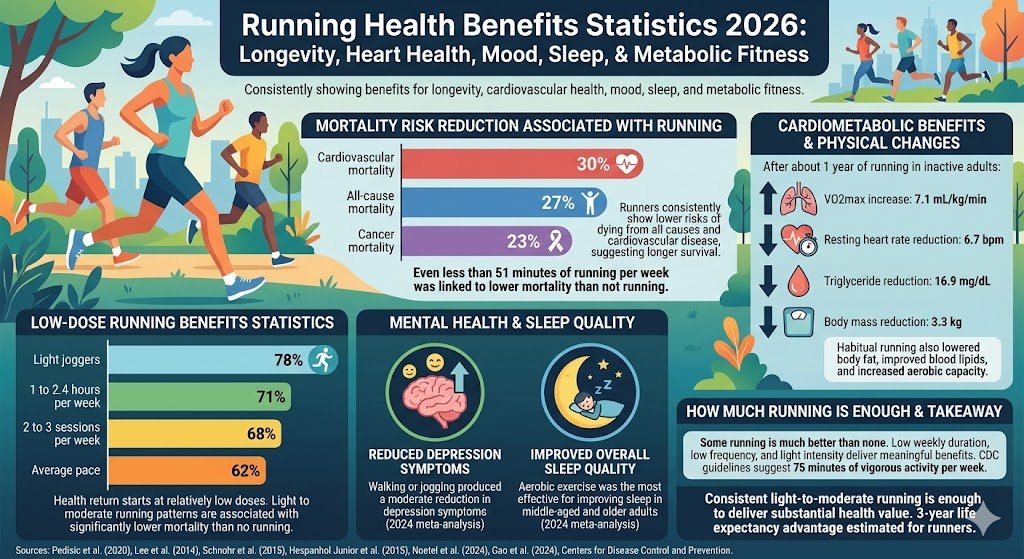
Running is one of the most studied forms of exercise, and the statistics consistently show benefits for longevity, cardiovascular health, mood, sleep, and metabolic fitness. Large cohort studies and meta-analyses suggest that even modest amounts of running are linked to meaningful health gains compared with not running at all.
running health benefits statistics
Key Running Health Benefits Statistics
Running was associated with 27% lower all-cause mortality in a large systematic review and meta-analysis.
Running was associated with 30% lower cardiovascular mortality in the same analysis.
Running was associated with 23% lower cancer mortality in the same analysis.
In a 55,137-adult cohort, runners had 30% lower all-cause mortality and 45% lower cardiovascular mortality than non-runners.
The same cohort estimated that runners had about a 3-year life expectancy advantage over non-runners.
Even less than 51 minutes of running per week was linked to lower mortality than not running.
Running 1 to 2 times per week was still associated with lower mortality than not running.
In the Copenhagen jogging study, light joggers had a hazard ratio of 0.22 versus sedentary non-joggers.
Jogging 1 to 2.4 hours per week had a hazard ratio of 0.29 versus sedentary non-joggers.
A meta-analysis of running interventions found a 3.3 kg reduction in body mass after about 1 year of training in inactive adults.
The same intervention meta-analysis found a 6.7 bpm reduction in resting heart rate and a 7.1 mL/kg/min increase in VO2max.
A 2024 meta-analysis reported that walking or jogging produced a moderate reduction in depression symptoms.
A 2024 sleep meta-analysis found aerobic exercise was the most effective exercise category for improving overall sleep quality in middle-aged and older adults.
Running and Mortality Statistics
The strongest evidence for running comes from long-term mortality data. Across both meta-analytic and cohort evidence, runners consistently show lower risks of dying from all causes and from cardiovascular disease in particular. The effect is important because it shows that running is not only linked to better fitness, but also to longer survival.
Mortality Risk Reduction Associated With Running
Label
Bar
Value
All-cause mortality
27%
Cardiovascular mortality
30%
Cancer mortality
23%
Max = 30%. Widths: All-cause mortality 90.00%, Cardiovascular mortality 100.00%, Cancer mortality 76.67%.
Low-Dose Running Benefits Statistics
One of the most useful findings in the research is that the health return from running starts at relatively low doses. That matters because it means people do not need marathon-level volume to get measurable benefits. Studies repeatedly show that light to moderate running patterns are associated with lower mortality than no running.
Selected Lowest-Mortality Running Profiles
Label
Bar
Value
Light joggers
78% lower mortality
1 to 2.4 hours per week
71%
2 to 3 sessions per week
68%
Average pace
62%
Max = 78%. Widths: Light joggers 100.00%, 1 to 2.4 hours per week 91.03%, 2 to 3 sessions per week 87.18%, Average pace 79.49%.
Cardiometabolic Benefits of Running
Running improves more than mortality outcomes. In intervention studies of inactive adults, habitual running reduced body mass, lowered body fat, improved blood lipids, reduced resting heart rate, and increased aerobic capacity. These changes help explain why running is so consistently associated with lower cardiovascular risk in larger population studies.
Body mass fell by 3.3 kg after about 1 year of running training in inactive adults.
Body fat percentage fell by 2.7 percentage points.
Resting heart rate fell by 6.7 beats per minute.
Triglycerides fell by 16.9 mg/dL.
HDL cholesterol increased by 3.3 mg/dL.
VO2max increased by 7.1 mL/kg/min.
One-Year Health Marker Changes From Running
Label
Bar
Value
VO2max increase
7.1
Resting heart rate reduction
6.7
Triglyceride reduction
16.9
Body mass reduction
3.3
Max = 16.9. Widths: VO2max increase 42.01%, Resting heart rate reduction 39.64%, Triglyceride reduction 100.00%, Body mass reduction 19.53%.
Running, Mental Health, and Sleep
Running also produces benefits outside of strictly physical risk factors. Evidence from recent meta-analyses suggests that jogging and other aerobic exercise formats can reduce depression symptoms and improve sleep quality. These findings are important because they show that running can affect both physical and psychological health at the same time.
For many people, that means the payoff from running is broader than weight control or race performance. Better mood, improved sleep, and stronger cardiorespiratory fitness can all reinforce one another and make the habit easier to maintain.
How Much Running Is Enough?
The data suggest that some running is much better than none. Low weekly duration, low frequency, and light jogging intensity have all been linked with meaningful benefit relative to inactivity. That makes running a practical health strategy for people who want measurable returns without very high training volume.
Current public health guidance also supports this idea. Adults can meet the weekly vigorous aerobic target with 75 minutes of vigorous exercise, which can include jogging or running, along with muscle-strengthening activity on 2 days per week.
Takeaway
The most important statistic about running may be that relatively small doses are already associated with major benefits. Running is linked to lower mortality, lower cardiovascular risk, improved metabolic markers, better mood, and better sleep quality. For most adults, the evidence supports a simple conclusion: consistent light-to-moderate running is enough to deliver substantial health value.
Sources
Pedisic Z, Shrestha N, Kovalchik S, et al. Is running associated with a lower risk of all-cause, cardiovascular and cancer mortality, and is the more the better? A systematic review and meta-analysis. British Journal of Sports Medicine. 2020.
Lee DC, Pate RR, Lavie CJ, et al. Leisure-time running reduces all-cause and cardiovascular mortality risk. Journal of the American College of Cardiology. 2014.
Schnohr P, O’Keefe JH, Marott JL, Lange P, Jensen GB. Dose of jogging and long-term mortality. Journal of the American College of Cardiology. 2015.
Van Gent Junior J, Siem D, van Middelkoop M, van Os AG, Bierma-Zeinstra S, Koes B. Incidence and determinants of lower extremity running injuries in long distance runners. Sports Medicine. 2015.
Hespanhol Junior LC, Pillay JD, van Mechelen W, Verhagen E. Meta-analysis of the effects of habitual running on indices of health in physically inactive adults. Sports Medicine. 2015.
Noetel M, Sanders T, Gallardo-Gomez D, et al. Effect of exercise for depression: systematic review and network meta-analysis of randomised controlled trials. BMJ. 2024.
Gao Y, Wang Y, Zhu X, et al. Comparative efficacy of different exercise types on sleep quality in middle-aged and older adults: a systematic review and network meta-analysis. Journal of Clinical Sleep Medicine. 2024.
Centers for Disease Control and Prevention. Benefits of Physical Activity and Adult Physical Activity Guidelines.