
Running remains one of the most popular and accessible fitness activities in the world. Recent participation reports from sports industry groups, race organizers, and training platforms show that both casual running and organized road racing continued to grow through 2024 and 2025. The strongest signs of momentum include more than 50 million U.S. participants, double-digit race-finisher growth across major distances, and a large jump in run-club activity.
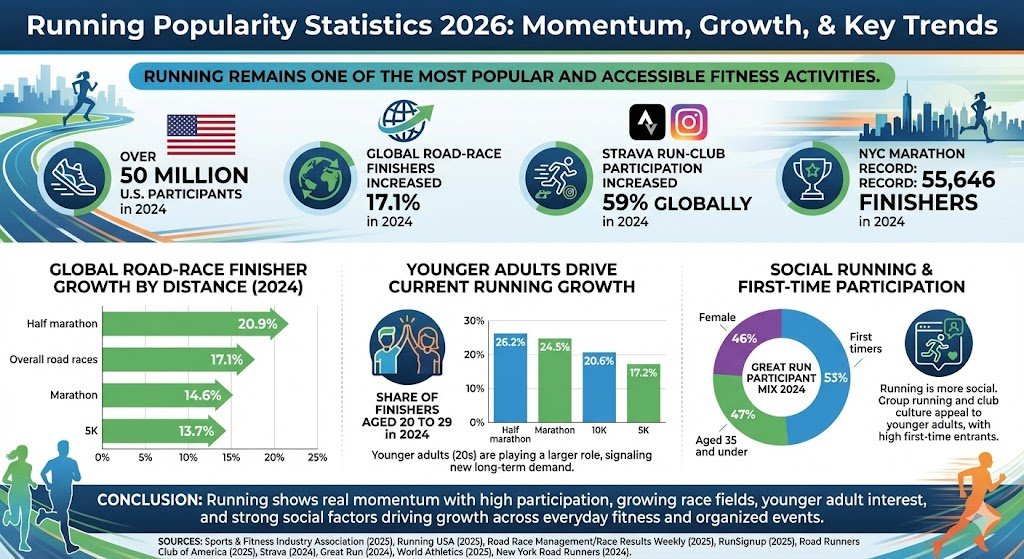
Key running popularity statistics
- Running and jogging exceeded 50 million U.S. participants in 2024.
- Global road-race finishers increased 17.1% year over year in 2024.
- Half-marathon finishers rose 20.9% in 2024.
- Marathon finishers increased 14.6% in 2024.
- 5K finishers increased 13.7% in 2024.
- The top 100 U.S. races across major distances grew finishers by an average of 15% in the second half of 2024.
- Average race participation increased 8% in 2024 and moved above 2019 levels.
- Run-club participation on Strava increased 59% globally in 2024.
- Great Run reported that 53% of its 2024 participants were first-timers.
- The 2024 New York City Marathon had 55,646 finishers, the largest marathon field on record.
Running participation is rising across everyday fitness and organized events
The latest running data shows growth at both ends of the market. Casual participation remains extremely high, while races from 5Ks to marathons are also attracting larger fields. That combination matters because it suggests running is growing not only as a daily exercise habit but also as a competitive and community-based activity.
Global race data shows especially strong momentum in the half marathon, though shorter and longer distances also posted double-digit gains. That broad spread is a sign of healthy interest across beginner, intermediate, and advanced runners.
Global road-race finisher growth by distance in 2024
| Label | Bar | Value | ||
|---|---|---|---|---|
| Half marathon |
| 20.9% | ||
| Overall road races |
| 17.1% | ||
| Marathon |
| 14.6% | ||
| 5K |
| 13.7% |
Max = 20.9%. Widths: Half marathon 100.00%, Overall road races 81.82%, Marathon 69.86%, 5K 65.55%.
U.S. race data supports the same overall trend. The largest races in the country reported strong finisher growth in late 2024, while registration data showed that the average event moved beyond pre-2020 participation levels. That suggests running is not just recovering. It is expanding again.
Younger adults are helping drive current running growth
A major shift in the current running cycle is age. The share of finishers in their twenties has risen across major race categories, showing that younger adults are playing a larger role in the road-race market. This matters because it points to new long-term demand rather than only older runners returning to events.
- Half-marathon finishers aged 20 to 29 accounted for 26.2% of the field in 2024.
- Marathon finishers aged 20 to 29 accounted for 24.5% of the field in 2024.
- 10K finishers aged 20 to 29 accounted for 20.6% of the field in 2024.
- 5K finishers aged 20 to 29 accounted for 17.2% of the field in 2024.
This younger age mix also appears in organizer data. Great Run reported that 47% of its 2024 entrants were aged 35 and under, while registration data showed meaningful participation from runners aged 18 to 29. Together, those numbers suggest a strong pipeline of new runners entering the sport.
Share of finishers aged 20 to 29 in 2024
| Label | Bar | Value | ||
|---|---|---|---|---|
| Half marathon |
| 26.2% | ||
| Marathon |
| 24.5% | ||
| 10K |
| 20.6% | ||
| 5K |
| 17.2% |
Max = 26.2%. Widths: Half marathon 100.00%, Marathon 93.51%, 10K 78.63%, 5K 65.65%.
Social running and first-time participation are major growth engines
Running is becoming more social as well as more popular. Group running and club culture have become a major part of the sport’s appeal, especially among younger adults. Fitness platforms reported a sharp rise in participation in running clubs, while race organizers also reported high levels of first-time entrants.
That combination matters because it changes how running spreads. New runners are often entering through friends, clubs, social events, and beginner-friendly race experiences rather than through traditional competitive pathways alone.
Great Run participant mix in 2024
| Label | Bar | Value | ||
|---|---|---|---|---|
| First timers |
| 53% | ||
| Aged 35 and under |
| 47% | ||
| Female |
| 46% |
Max = 53%. Widths: First timers 100.00%, Aged 35 and under 88.68%, Female 86.79%.
These figures show why running continues to expand. It is inexpensive, easy to start, widely social, and flexible enough for both casual exercise and ambitious race goals. That mix makes it one of the broadest-participation sports in the market.
Major races continue to reflect strong demand
Large flagship events are another sign of the sport’s popularity. The New York City Marathon set a record with 55,646 finishers in 2024, while international road-race reporting counted millions of finishers across major events worldwide. When the biggest races keep expanding, it usually signals strong demand across the broader running ecosystem.
Conclusion
The newest running popularity statistics point to a sport with real momentum. Participation is high, race fields are growing, younger adults are more visible, and social running is helping attract first-timers. Across both everyday fitness and organized events, running remains one of the most popular and still-growing activities in the world.
Sources
- Sports & Fitness Industry Association, Topline Participation Report summary, 2025.
- Running USA, Top 100 U.S. Races report release, 2025.
- Road Race Management and Race Results Weekly, global road-race finisher survey, 2025.
- RunSignup, RaceTrends report summary, 2025.
- Road Runners Club of America, Gen Z race participation summary, 2025.
- Strava, Year in Sport Trend Report, 2024.
- Great Run, Rewind24 participation summary, 2024.
- World Athletics, Annual Report and Accounts, 2025.
- New York Road Runners, 2024 year-end summary, 2024.
