The running shoe market is growing, but published totals still vary depending on how analysts define the category. Some forecasts isolate running shoes only, while others compare the category against the wider athletic footwear industry.
Even with that variation, the overall direction is consistent. The category is expanding, premium performance product is gaining momentum, and major brands are using innovation, race visibility, and direct demand generation to capture more sales.
running shoe market statistics
Key running shoe market statistics
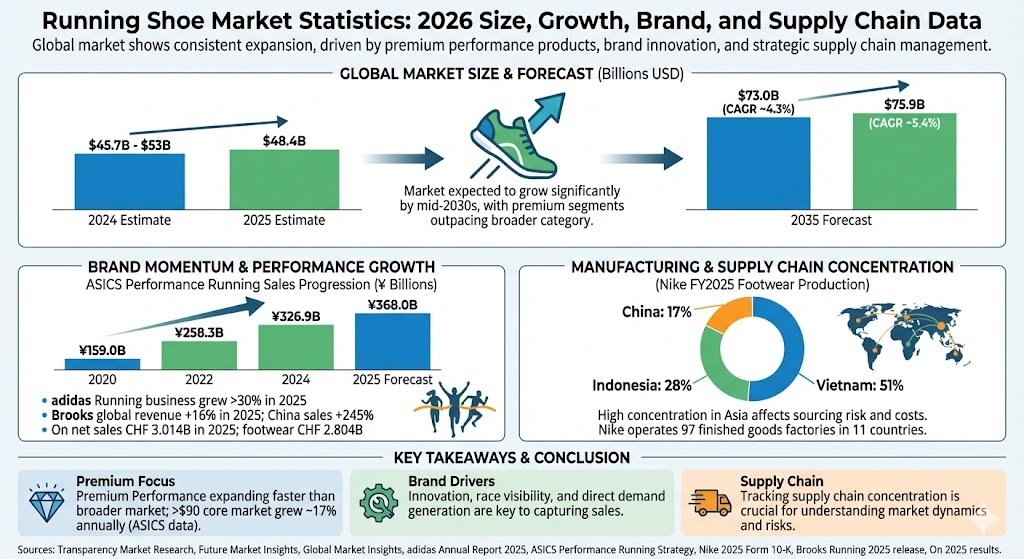
The global running shoes market was valued at US$45.7 billion in 2024 in one major forecast.
That forecast projects the market to reach US$73.0 billion by 2035.
The implied growth rate in that forecast is 4.3% CAGR from 2025 to 2035.
Another forecast estimates the running shoes market at US$48.4193 billion in 2025.
That second forecast projects the market to reach US$75.9164 billion by 2035.
The running shoes segment generated about US$53 billion in 2024 within the broader athletic footwear market.
Global Market Insights said the running shoes segment is expected to grow at about 5.4% CAGR from 2025 to 2034.
adidas said its Running business grew by more than 30% in 2025.
ASICS said the combined running shoe market across Japan, the U.S., and Europe was about ¥1.85 trillion in 2024.
ASICS said the overall running shoe market across those regions grew at about 7% annually over the past two years.
ASICS said the US$90-and-above core running market grew at about 17% annually over the past two years.
Nike said Vietnam, Indonesia, and China accounted for 51%, 28%, and 17% of NIKE Brand footwear production in fiscal 2025.
Running shoe market size and forecast statistics
The clearest market takeaway is that running footwear remains a large global category with steady long-term growth. Forecasts differ on exact size, but they point in the same direction: a bigger market by the mid-2030s and faster momentum in premium performance product.
Transparency Market Research valued the running shoes market at US$45.7 billion in 2024.
That same source projected the market to reach US$73.0 billion by 2035.
Future Market Insights estimated the market at US$48.4193 billion in 2025.
That source projected the market to reach US$75.9164 billion by 2035.
Global Market Insights estimated the running shoes segment at about US$53 billion in 2024.
That segment forecast implies running shoes remain one of the largest product groups in athletic footwear.
Selected published running shoe market estimates
Label
Bar
Value
2024 market size
US$45.7B
2025 market size
US$48.4193B
2035 forecast A
US$73.0B
2035 forecast B
US$75.9164B
Max = 75.9164. Widths: 2024 market size 60.20%, 2025 market size 63.78%, 2035 forecast A 96.16%, 2035 forecast B 100.00%.
Brand momentum statistics
Brand-level results show that performance running is still one of the strongest growth engines in sports footwear. The biggest winners are brands with clear product differentiation, strong marathon visibility, and a premium pricing strategy.
adidas said its Running business grew by more than 30% in 2025.
ASICS said it held about 10% of the 2024 running shoe market across Japan, the U.S., and Europe.
ASICS projected Performance Running sales of ¥368.0 billion in 2025.
ASICS Performance Running sales were ¥326.9 billion in 2024.
Brooks said global revenue increased 16% in 2025.
Brooks said China sales increased 245% in 2025.
On reported CHF 3.014 billion in 2025 net sales.
On said footwear generated CHF 2.8044 billion in 2025 sales.
Supply chain concentration still matters in running footwear because it affects sourcing risk, costs, production flexibility, and tariff exposure. Nike’s footprint offers a useful snapshot of how concentrated footwear manufacturing remains across Asia.
Nike said contract manufacturers operated 97 finished goods footwear factories in 11 countries as of May 31, 2025.
Vietnam produced 51% of NIKE Brand footwear in fiscal 2025.
Indonesia produced 28% of NIKE Brand footwear in fiscal 2025.
China produced 17% of NIKE Brand footwear in fiscal 2025.
Nike footwear production by country in fiscal 2025
Label
Bar
Value
Vietnam
51%
Indonesia
28%
China
17%
Max = 51. Widths: Vietnam 100.00%, Indonesia 54.90%, China 33.33%.
Conclusion
The running shoe market is still growing, but the more important shift is where that growth is happening. Premium performance footwear is expanding faster than the broader category, and brands with strong race credibility and differentiated product are capturing more of the upside.
That means tracking the market now requires more than a single headline size figure. The most useful indicators are premium-tier growth, brand momentum, and supply-chain concentration.