
Running is one of the most effective forms of cardio for creating a calorie deficit, but the data shows that weight loss results depend on pace, weekly volume, diet, and consistency. The strongest evidence suggests that running can support meaningful fat loss, especially when it helps you reach at least 150 minutes of moderate-to-vigorous aerobic exercise per week and when it is paired with a lower-calorie eating plan.
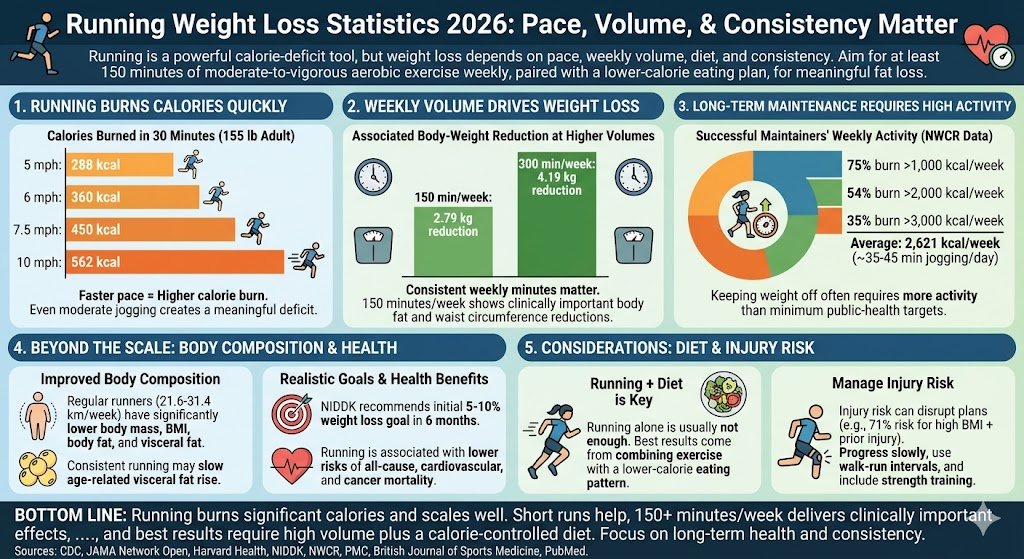
Key Running Weight Loss Statistics
- Adults can meet the baseline aerobic activity target with 75 minutes of vigorous exercise per week, which includes jogging or running.
- A 2024 meta-analysis of 116 randomized trials covering 6,880 adults with overweight or obesity found that each additional 30 minutes of aerobic exercise per week was associated with 0.52 kg lower body weight, 0.56 cm less waist circumference, and a 0.37% lower body fat percentage.
- In that same meta-analysis, 150 minutes of aerobic exercise per week was associated with 2.79 kg lower body weight.
- At 300 minutes per week, the associated body-weight reduction rose to 4.19 kg.
- Body fat percentage reduction was greatest at 150 minutes per week, reaching 2.08%.
- For a 155-pound adult, running for 30 minutes burns about 288 calories at 5 mph, 360 calories at 6 mph, 450 calories at 7.5 mph, and 562 calories at 10 mph.
- A 2023 study found that recreational runners averaging 21.6 to 31.4 km per week had significantly lower body mass, BMI, body fat, and visceral fat than inactive adults across ages 18 to 65.
- Among successful long-term weight-loss maintainers in the National Weight Control Registry, the average maintained loss was 32.3 kg over 5.8 years.
- National Weight Control Registry participants reported an average of 2,621 kcal of physical activity per week, which translates to about 35 to 45 minutes of vigorous activity such as jogging per day.
- About 75% of National Weight Control Registry entrants reported more than 1,000 kcal per week in activity, 54% exceeded 2,000 kcal, and 35% exceeded 3,000 kcal.
- Among U.S. adults trying to lose weight, 60.6% reported using exercise as a strategy.
- NIDDK recommends an initial weight-loss goal of 5% to 10% of starting body weight within 6 months.
- U.S. adult obesity prevalence was 40.3% during August 2021 to August 2023.
- A meta-analysis in the British Journal of Sports Medicine found that running participation was associated with a 27% lower risk of all-cause mortality, a 30% lower risk of cardiovascular mortality, and a 23% lower risk of cancer mortality compared with not running.
- A 2025 cohort study found that runners with a BMI above 30 and a previous running-related problem had a 71% injury risk up to 1,000 km, versus 43% in runners with a BMI of 19 to 25 and no previous running-related problem.
Running Burns A Lot Of Calories In A Short Time
Running is popular for weight loss because calorie burn rises quickly as pace increases. Even a moderate jog can produce a meaningful calorie deficit, and faster running makes the numbers climb even more.
Calories Burned In 30 Minutes Of Running For A 155-Pound Adult
| Label | Bar | Value | ||
|---|---|---|---|---|
| 5 mph |
| 288 calories | ||
| 6 mph |
| 360 calories | ||
| 7.5 mph |
| 450 calories | ||
| 10 mph |
| 562 calories |
Max = 562 calories. Widths: 5 mph 51.25%, 6 mph 64.06%, 7.5 mph 80.07%, 10 mph 100.00%.
Meaningful Weight Loss Usually Requires Weekly Volume
The best evidence does not support the idea that a couple of short runs per week will drive major fat loss on their own. Instead, weight loss tends to improve as total aerobic exercise time increases. Running is one of the most practical ways to reach these higher volumes because it is vigorous and time-efficient.
Associated Body-Weight Reduction At Higher Weekly Aerobic Exercise Volumes
| Label | Bar | Value | ||
|---|---|---|---|---|
| 150 min/week |
| 2.79 kg | ||
| 300 min/week |
| 4.19 kg |
Max = 4.19 kg. Widths: 150 min/week 66.59%, 300 min/week 100.00%.
That same meta-analysis also found that 150 minutes per week was enough to produce clinically important reductions in waist circumference and body fat, and that body fat percentage reduction reached 2.08% at that volume. In practice, that means running can help with weight loss, but consistent weekly minutes matter more than occasional hard efforts.
Long-Term Weight-Loss Maintenance Usually Involves A Lot Of Activity
Losing weight is one thing. Keeping it off is usually harder. Data from the National Weight Control Registry shows that successful weight-loss maintainers tend to stay highly active over the long run.
Share Of National Weight Control Registry Entrants Meeting Weekly Activity Thresholds
| Label | Bar | Value | ||
|---|---|---|---|---|
| At least 1,000 kcal/week |
| 75% | ||
| At least 2,000 kcal/week |
| 54% | ||
| At least 3,000 kcal/week |
| 35% |
Max = 75%. Widths: At least 1,000 kcal/week 100.00%, At least 2,000 kcal/week 72.00%, At least 3,000 kcal/week 46.67%.
The registry’s average activity level was 2,621 kcal per week, which researchers estimated to be roughly equal to 35 to 45 minutes of vigorous activity such as jogging per day or 60 to 75 minutes of moderate activity such as brisk walking per day. That does not mean everyone needs the same amount, but it does show that long-term maintenance often requires more activity than the minimum public-health target.
Running Improves More Than The Number On The Scale
Weight loss is only part of the story. In a 2023 study of adults aged 18 to 65, runners who averaged 21.6 to 31.4 km per week had significantly lower body mass, BMI, body fat, and visceral fat than inactive adults. The study also found that the oldest runners had visceral fat levels closer to much younger inactive groups, which suggests that consistent running may help slow the age-related rise in harmful abdominal fat.
That matters because weight loss goals are often framed around the scale alone, while fat distribution can be even more important for health. The 2024 dose-response meta-analysis found that each additional 30 minutes of aerobic exercise per week was associated with a 1.60 cm² reduction in visceral adipose tissue, reinforcing the value of regular aerobic training for changing body composition and not just body weight.
Running Alone Is Usually Not Enough
Running can help create the calorie deficit needed for weight loss, but it rarely works as a stand-alone solution. NIDDK notes that physical activity may not have a big impact on weight loss by itself, even though it delivers important health benefits independent of weight loss. That is why the best results typically come from combining running with a lower-calorie eating pattern, enough sleep, and long-term consistency.
The realistic target is also more modest than many people expect. Federal guidance recommends an initial goal of losing 5% to 10% of starting body weight within 6 months. For someone starting at 200 pounds, that means 10 to 20 pounds, not an overnight transformation.
Injury Risk Can Disrupt Weight Loss Plans
Running is accessible, but it is not friction-free. The 2024 aerobic exercise meta-analysis reported mostly musculoskeletal adverse events, with about 2 more mild-to-moderate events per 100 participants. A newer 2025 cohort study found that runners with a BMI above 30 and a previous running-related problem had a 71% injury risk up to 1,000 km, compared with 43% for runners with a BMI of 19 to 25 and no previous running-related problem.
For weight loss, that makes progression especially important. Slower build-ups, walk-run intervals, recovery days, and strength training can help protect consistency, which is often the biggest predictor of long-term results.
Bottom Line
Running is one of the most efficient exercises for supporting weight loss because it burns a lot of calories, scales well from beginner to advanced levels, and can help reduce body fat and visceral fat over time. The evidence points to three practical takeaways: short runs help, 150 minutes per week is where clinically important fat-loss effects start to show up, and larger results usually require a higher weekly volume plus a calorie-controlled diet. For many people, the real value of running is not just losing weight, but keeping it off while improving long-term health at the same time.
Sources
- CDC, Adult Activity: An Overview
- JAMA Network Open, Aerobic Exercise and Weight Loss in Adults: A Systematic Review and Dose-Response Meta-Analysis
- Harvard Health, Calories Burned in 30 Minutes of Leisure and Routine Activities
- NIDDK, Choosing a Safe and Successful Weight-Loss Program
- National Weight Control Registry, Physical Activity Patterns in the National Weight Control Registry
- PMC, Demographic Correlates of Weight-Loss Strategies in US Adults: Cross-Sectional Analysis of NHANES Data 2017–2020
- CDC/NCHS Data Brief No. 508, Obesity and Severe Obesity Prevalence in Adults
- PMC, The Effect of Regular Running on Body Weight and Fat Tissue of Individuals Aged 18 to 65
- British Journal of Sports Medicine, Is Running Associated With a Lower Risk of All-Cause, Cardiovascular and Cancer Mortality?
- PubMed, Runners With a High Body Mass Index and Previous Running-Related Problems Is a High-Risk Population for Sustaining a New Running-Related Injury
